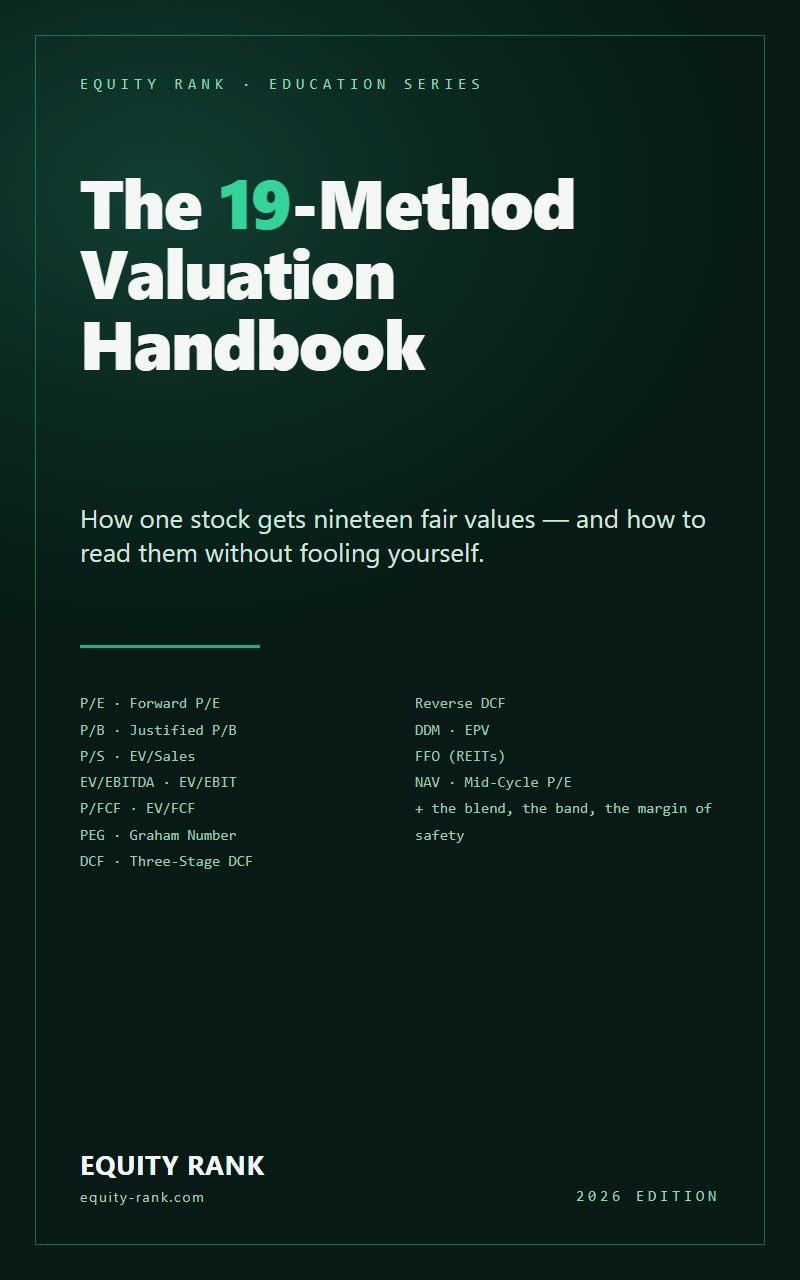
The 19-Method Valuation Handbook
How one stock gets nineteen fair values — and how to read them. Nineteen valuation methods — P/E to DCF, the Graham Number to earnings power value, FFO to NAV — each explained the same way: what it measures, the formula as the Equity Rank engine actually implements it, the inputs it needs, where it applies, where it breaks, and a worked example with real arithmetic. Then what happens after the nineteen numbers exist: the sector-aware blend, the 80% band, the margin of safety, and a reading habit for any fair value you meet.
27,700 words · 124 pages (6×9) · Leek Ventures LLC (dba Equity Rank)
The Kindle edition and the PDF + EPUB bundle are being listed now. Leave your email below and we will send one note when they are live — nothing else.
What is inside
Nine parts, thirty-one chapters, five appendices
PART I
Foundations
- What a fair value is (and is not)
- Price, value, and the margin of safety
- Why nineteen methods instead of one
- The inputs every method shares
PART II
The Multiples Family
- P/E and forward P/E
- P/B
- P/S and forward P/S
- EV/EBITDA
- EV/EBIT
- EV/Sales
- P/FCF
- EV/FCF
PART III
Growth and Conservatism
- PEG fair value
- The Graham Number
- Justified P/B
PART IV
Cash Flow and Income
- Discounted cash flow
- Three-stage DCF
- Reverse DCF (implied growth)
- Dividend discount model
- Earnings power value
PART V
Sector Specialists
- FFO for REITs
- NAV for commodity producers
- Mid-cycle P/E for cyclicals
PART VI
Beyond the Nineteen
- Residual income, EVA, CAPE, P/TBV, the H-model, AFFO, the options-implied forward, and rNPV
PART VII
From Methods to a Verdict
- The blend
- The band
- Margin of safety, required margin of safety, and the labels
- SAVE, Fundamental Strength, and the Equity Rank Score
- How to read a verdict
PART VIII
Worked Examples and Post-Mortems
- Seven dated walkthroughs on real companies
- Four post-mortems — three of them model misses
APPENDICES
Reference
- One-page formula sheet
- Glossary
- Ten-question knowledge check with answers
- Further reading
- Disclaimer
How the book is kept honest
- Two fictional companies run through every method — a mature industrial and a fast-growing software company — so the nineteen values can be compared side by side. Every number reproduces from the inputs stated in each chapter.
- Formulas mirror the engine, including its guards and the corrections it has published: the target-PEG fix, the net-debt bridge, the DCF reinvestment debit, the 100× dividend cap, the weight-aware outlier trim, and the coverage and dispersion shrinks.
- Real companies appear only in dated walkthroughs reproduced from our worked-examples library — seven walkthroughs and four post-mortems, three of which are cases where the model was wrong, stated in full.
- Reviewed for compliance before publication. Every fair value in the book is a model estimate under stated assumptions — not a prediction, forecast, or target of where a security will trade — and the book says so before its first number and again at its end.
Free Weekly Update
3,000+ stocks re-scored every week.
Delivered free every Sunday.
- Top 5 most undervalued stocks by margin of safety — with valuation breakdown
- Biggest score changes from the prior week across 3,000+ equities
- Best options setups from the screener (covered calls, cash-secured puts)
Research and educational purposes only. Not investment advice.
The engine the book describes
Every method in the Handbook runs nightly on 3,000+ U.S. stocks
The methodology page publishes the per-method derivations and the live factor diagnostics; the free calculators let you work any chapter's example yourself.
Common Questions
Who is the Handbook for?
Self-directed investors, students, and analysts who want to understand how each of nineteen valuation methods works — the formula as a real engine implements it, the inputs it needs, where it applies, where it breaks — and how many methods are blended into one model fair value estimate with an uncertainty band. It assumes no prior finance training; Part I defines every shared term.
Does the book tell me what to own?
No. It is educational. It explains methods and shows worked examples on two fictional companies and, in Part VIII, dated model outputs on real companies — including three post-mortems in which the model was wrong. Every figure is a model estimate under stated assumptions, not a prediction of where a security will trade, and nothing in it is investment advice. Leek Ventures LLC (dba Equity Rank) is not a registered investment adviser.
Do I need an Equity Rank subscription to use it?
No. Every formula can be worked by hand or in a spreadsheet, and Appendix A is a one-page formula sheet for exactly that. The book refers to the engine's methodology page and free calculators, which are public.
In what formats is it available?
A Kindle ebook on Amazon and a PDF + EPUB bundle sold directly. The free sample on this page is the front matter and Part I as a PDF. A 6×9 paperback is planned.
How was it written?
The text was generated with AI tools working from Equity Rank's published methodology, the valuation engine's formula reference, and the education library, then reviewed, corrected, and edited by a human before publication, and reviewed for legal compliance. The book says so in its front matter, and Amazon has been given the same disclosure.